
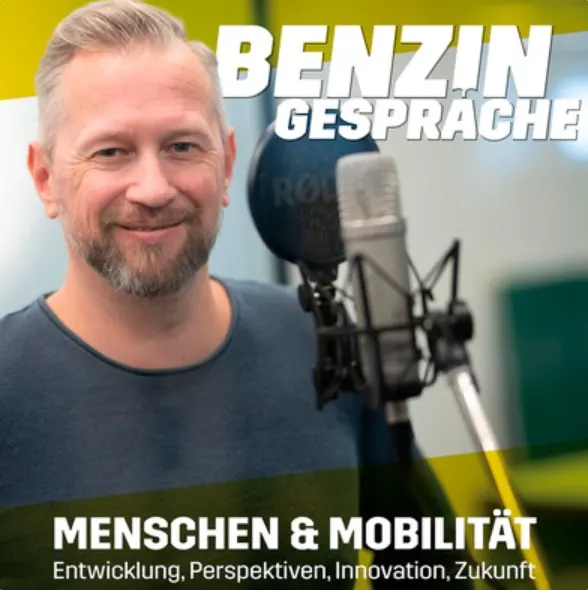
Benzingespräche · Folge 81 · · 30 Min
Ajay Bhatia, CEO mobile.de
Kernaussagen
- AJ Batia bringt einen globalen Blickwinkel in die deutsche Automobilbranche.
- Mobile.de setzt auf verbesserte Benutzererfahrungen und Anpassung an neue Mobilitätstrends.
- Elektrofahrzeuge stellen den Markt vor Herausforderungen, insbesondere in Bezug auf Kosten und Technologie.
- Leasing- und Abonnementmodelle gewinnen an Bedeutung.
- Nachhaltigkeit und Zusammenarbeit zwischen Händlern und OEMs sind entscheidend für die Zukunft des Autohandels.
Worum es geht
Unternehmensspecial mit mobile.de Was gibt´s Neues bei mobile.de? Zum einen wird die Plattform natürlich immer weiter entwickelt und es kommen neue oder einfachere Lösungen "an den Start", die es Kunden und Händlern einfacher machen, Fahrzeuge zu handeln. Nun gibt es aber eben auch seit August 2022 einen neuen CEO bei mobile.de, Ajay Bhatia. Er verantwortet also die Weiterentwicklung des Unternehmens und der zukünftigen Strategie. Grund genug, mit ihm in Ruhe einmal zu sprechen und mehr über ihn, seinen Werdegang, Ansichten und Zukunftsperspektiven zu sprechen. Dabei sprechen wir natürlich auch über das Zusammenspiel von mobile.de, Händlern und Endkunden. Aber auch über den sich verändernden Gebrauchtwagenmarkt durch immer mehr Elektrofahrzeuge, die in diesem Segment auf den Markt kommen. Ajay gibt viele Einblicke in diese Themen und ist abgesehen von seiner fachlichen Kompetenz ein absolut sympathischer Mensch. Hört es euch an! Links: www.mobile.de/ Ajay Bhatia auf LinkedIn: www.linkedin.com/in/ajayaus/
Zusammenfassung
In der neuesten Episode von Benzingespräche begrüßt Tim Klötzing AJ Batia, den CEO von mobile.de. Gemeinsam diskutieren sie die Herausforderungen und Chancen der Elektromobilität im deutschen Autohandel und wie mobile.de als Marktführer diese Entwicklungen angeht.
AJ Batia: Ein globaler Blick auf den Autohandel
AJ Batia, gebürtig aus Indien und mit einer beeindruckenden Karriere in Australien, bringt einen einzigartigen globalen Blickwinkel in die deutsche Automobilbranche. Seit August 2022 ist er CEO von mobile.de, Deutschlands größtem Marktplatz für Autoverkäufe. Im Podcast erzählt AJ von seinen Beweggründen, nach Deutschland zu kommen, und wie seine internationale Erfahrung seine Arbeit bei mobile.de beeinflusst.
Die Rolle von mobile.de in der Elektromobilität
Mobile.de ist ein zentraler Akteur im deutschen Autohandel. AJ Batia betont die Bedeutung von Benutzererfahrungen und die Notwendigkeit, sich an die sich ändernden Mobilitätstrends anzupassen. Die Plattform setzt auf eine verbesserte Nutzererfahrung, um sowohl Käufern als auch Verkäufern den bestmöglichen Service zu bieten. AJ erklärt, dass die Zukunft von mobile.de in der Anpassung an neue Technologien und Geschäftsmodelle liegt, insbesondere im Bereich der Elektromobilität.
Herausforderungen der Elektromobilität
Die steigende Nachfrage nach Elektrofahrzeugen stellt den Markt vor Herausforderungen. AJ spricht über die hohen Kosten von Elektroautos und die damit verbundene Unsicherheit bezüglich der Batterietechnologie. Diese Faktoren führen dazu, dass viele Kunden Leasing- oder Abonnementmodelle bevorzugen. Mobile.de reagiert darauf mit Angeboten wie Null Leasing, das sich auf Elektro- und Hybridfahrzeuge spezialisiert hat.
Die Zukunft des Autohandels
AJ Batia sieht die Zukunft des Autohandels in einer stärkeren Zusammenarbeit zwischen Händlern und OEMs. Er betont die Bedeutung von Nachhaltigkeit und die Notwendigkeit, sich an veränderte Kundenbedürfnisse anzupassen. Mobile.de wird weiterhin daran arbeiten, seine Plattform zu optimieren und den Autohandel in eine nachhaltige und digitale Zukunft zu führen.
Fazit
Der Podcast mit AJ Batia bietet wertvolle Einblicke in die strategischen Überlegungen von mobile.de und die Herausforderungen der Elektromobilität im deutschen Autohandel. Mit einem klaren Fokus auf Benutzererfahrung und Nachhaltigkeit ist mobile.de gut positioniert, um den Wandel in der Branche aktiv mitzugestalten.
Links aus der Folge
Gespräch als Text
Automatisch erstellte Abschrift, Namen abgeglichen.
00:00 Benzingespräche. Der Branchen- und Personality-Talk der deutschen Automobilwirtschaft. Der Podcast für und mit Menschen aus der deutschen Automobilbranche, die etwas zu sagen haben. Wir teilen die Liebe zum Automobil in persönlichen Erfolgsstories, die es wert sind, erzählt zu werden. Es geht um neue und verschiedene Blickwinkel auf die Autobranche und persönliche Meinung zukünftiger Geschäftsmodelle und Mobilitätskonzepte. Vom prüfenden Blick in den Rückspiegel bis zur spannenden Aussicht mit Fernlicht in die mobile Zukunft. Ich bin Tim Klötzing, Experte der deutschen Autobranche, Content-Creator und freier Automarketing-Berater. Herzlich willkommen zurück bei meinem Podcast Benzingespräche. Heute mit einem Unternehmensspecial und zwar mit mobile.de. Okay, mobile.de kennt jeder, egal ob Endkunde, Handel oder auch OEMs. Dennoch gibt es auch immer Blickwinkel, Neuigkeiten und Entwicklungen an und in solchen großen Playern im deutschen Autohandel, die besprochen werden wollen. Dynamische Zeiten eben. Dazu steht uns heute nicht irgendjemand zur Verfügung, sondern direkt der seit August 2022 neue CEO AJ Bhatia. Hi AJ, it's a pleasure to have you here on my show today. I'm very glad to be here, Tim. Heute werden wir auf Englisch den Podcast machen. AJ ist noch nicht so
01:29 richtig sicher in Deutsch. Er kann eins, zwei, drei, vier, fünf, vielleicht auch sieben Sätze auf Deutsch, aber da haben wir doch ein paar mehr. A bit more questions that we should talk in English, right? Thank you. Yeah, I do speak very little Deutsch, a bit new to Germany at the moment. Thank you for doing this in English. Yes, you're welcome. Sure. I'm pretty happy that you took the time for this podcast and share your thoughts on some insights with us. So before we talk about Mobility, we were going to talk a bit about you. So AJ, you were born in India and spent most of your professional life in Australia. What made you decide to come all the way from the other side of the globe to pursue a new life in Germany? I guess if we look at the weather here, it cannot be the weather, right? Well, it's not the weather, but you know, as you get older and older and you acquire more gray hair, one of the things you realize in life is owning things is interesting. But what is far more interesting is experiences in life. And you can't just get experiences by being in one place all the time. So I'm very lucky that I have been able to travel from Australia to Europe to get a bit of a European experience and an immersion into the European culture. And I'm really enjoying being
02:57 in Germany. I'm also visiting lots of adjoining countries as well. For example, this weekend, my uncle's here from Washington and we are going to Prague and, you know, it's a short drive from here. Then Monday and Tuesday, I'm going to Barcelona for work. And then the family is going with me for east to Greece. And these kinds of things never happened in Australia, because all we did is went from Sydney to Melbourne and from Melbourne to Adelaide. And maybe sometimes we went to Bali, but you couldn't say that you drove to Prague on the weekend, right? So it's interesting. Oh, yeah, it's interesting. But let me let me just point out that the other side that you were like, left behind is also quite attracting a German dude here.
03:43 So you spent 13 years of building an online and car sales company in Down Under. Did mobile.de hire you for your background in cars or in your background in e-commerce? I mean, probably a mix of the two. It's hard for me to tell you exactly why they chose me because they had some other very good candidates as well that they could have chosen from. I mean, I would say that I'm an online classified specialist for the last 20 years. I've worked in digital businesses, particularly with an interest in automotive digital businesses. I'm passionate about cars. I've always loved cars. I've always had an interest in 911s. So good to be in Germany from that sense, right? But at the same time, right now I'm driving an electric car and making the sustainable choices that I should correctly be making. In fact, I'm even subscribing to one at the moment and looking at buying an electric car in the near future. So I would say it's just the combination of my experience and my interest in cars. And hopefully they heard some good things about what I did.
05:04 I guess they chose you. So something must have been in your records that they chose you finally. And it's funny. You said like, it's so, so clear to me to love cars. It's not, it's not clear. I know for everybody outside the car bubble, I know, but it's so, so easy, you know? Yeah. Yeah, absolutely. I mean, my favorite car still is the 911 and I had a 911 convertible for about six years in Australia. And I absolutely love that car. It's not on the script, but do you have a sense where your love for cars come from? My last four cars? No, no, your love, your heart for cars. Oh yes. Your passion. Oh yes. My, my, yeah. Um, so what I, why I love cars. Look, um, I mean, I, I, I was an engineer, um, long before I became a manager. So I've always been a bit of an engineer at heart and I've always been fascinated by, um, engineering feats and building things and what's better than building a car for me anyway.
06:14 Uh, and, and they look so beautiful as well. It's not just the engine and the performance, it's the aerodynamics of the car and those fine details. Um, and the fine engineering feats are putting a little bit of carbon fiber here, a little bit of carbon fiber there. How do you make it lower? How do you make it wider? How does it handle corners? Like I love all of those details and it's just, uh, it's maybe it's still the kid in me, right? That, that that's never grown up. And I always loved cars and I was born in, in a fairly middle-class family and I guess I couldn't afford all the really fancy German cars back then. Um, so that probably created even more of a desire to, um, to experience these cars. How you answered this question. You are so right in the Benzingespräche podcast.
07:08 Yeah. It's, uh, you are so, so right here right now. Awesome. Let's get back on track here. Um, you spend, or you have been in Germany for around eight months now. What has surprised you positively and, um, what took you time to get used to both like personally and professionally? Um, I think positive, lots of positives, right? So when I first came here, I found, um, some of my friends who I studied with. Fortunately, there were a couple of friends who I studied with who were in Germany. And they were the first ones that, that I had dinner with, with my family. And what I found was the local Germans, maybe it was the history of the war, but it, it really has affected the psychology of people here. And, and the modern German is a very interesting person who partly is shaped by some of the things that happened in the war. And, and you can see how, um, it's made them very empathetic, very kind, very accepting, especially here in Berlin, uh, where, where it's so multicultural.
08:20 It's, uh, Melbourne's very multicultural as well, which is the city I come from before. And I was, um, I was scared that I would miss the multiculturalism here, but when I came to Berlin, I found that it's still very multicultural and, um, you know, it's the other many, many good things as well, such as, um, I, I find, um, things, things are overall well-organized here, even though slightly on the negative side, I did find the bureaucracy very, very difficult to deal with, um, which, which I had heard before as well, but I, I never thought that it would be that difficult. Um, so it, I found it pretty difficult, um, and the processes and so on, but overall, um, you know, very good experience, especially here at mobility, which is where I experienced Germany the most, because I'm at work the most. Um, and, uh, the people here at mobility are, are amazing, which, which really makes my, um, life here in Germany a pleasure because I'm dealing with really nice people. And I'm, I'm, I make sure that I come into work every day. So I rarely work from home.
09:35 And the reason I come to work is I want to meet the people. I want to sit down and have lunch with someone from mobility who I don't know. Um, but shortly I will get to know because I'm going to have lunch with them. So, um, and that's how I experienced it. Oh, that's awesome. I really like that. This multicultural thing is really awesome that you mentioned that. And as well as I was like, when you were talking about, uh, bureaucracy, I'm 47 years old now, and I'm still not used to that. So it's just, that's part of the deal in in Germany. Let's talk about mobility. Mobility is Germany's largest car sales marketplace and has been the market leader for many, many years. How do you plan the further advance of the company?
10:29 Yes. Mobility is, um, as you correctly pointed out, uh, the clear number one, uh, destination for car buyers and sellers here in Germany. And also for people like me who are just passionate about cars, even when you're not buying, you're just looking at cars and just dreaming and imagining. Um, and you know, the, the future of firstly, the fundamental thing that builds a marketplace is choice, the choice for buyers and sellers and mobility has the largest choice. So I'm very proud that we have that. Um, but at the end of the day, what is that we're doing into the future? We are really, uh, driving user experience. People who come to mobility, whether they buy cars, sell cars, or just dream about cars, or they just want to use cars. Um, we want to improve their experience of owning a car, selling a car, buying a car, or simply using a car. Um, and how are we going to do that?
11:31 I think the world around us is changing and changing a lot, especially in the world of mobility. You know, I sort of liken it to, um, we are driving a car and the, you know, the, for mobile mobile is this car, or you can call it a bus internally. I call it a bus and we're driving this bus. We're all together sitting in this bus. We're going on the open highway. There are no limits to where this highway ends because there are endless opportunities, but there are a lot of hills around the highway. There's a lot of potholes on the highway. And unless we sit there and intentionally drive this bus around the potholes, collectively work together to make this bus more efficient, to be able to drive up that hill, we're not going to be able to achieve our vision.
12:23 And our vision, um, is driven by the change in mobility, the, the rise of electric cars, the rise of the agency model, and the balance of power, uh, slowly shifting away from small dealers to OEMs, especially for new cars. All of these contexts, the context of sustainability, the context of emissions, the context of the, generally people, um, starting to think about subscriptions or leasing, et cetera. All of those contexts are very, very important for us because the drive up of electric cars means that there are, there is more leasing in the market. We have a business called Noodle Leasing that we own, uh, 75% of the cars that we lease are either electric or hybrid. And why is that? Why is this, this very strong relationship between electric and leasing? It's because electric cars at the moment are very, very expensive. Um, and as a result, people want to lease or subscribe to them rather than buy them because they can't afford to buy them. Uh, Germany is one of the richest countries in the world, but even here for, for us, for the average German, the electric cars are still very expensive. Then there is the concept of Germans are worried about, um, will the battery technology change? And at the moment, it's pretty common to have a three, 400 kilometer range, but will the common range become 1000 and the cars with the range of 300, what will be the residual value of these
13:50 cars? So if someone spends 70, 80,000 euros, which is a very large amount on a car, all need to find out in three or four years, they're worth a lot less than that. Uh, that is not a good experience and that drives anxiety. So we're watching all of these user trends. And we, so one of the things that we are very keen on is we are keen on helping our customers, our dealers, um, in, in particular with navigating this journey, because it's not going to be easy for the dealers, for our car dealers. And we believe that by helping our dealers, we will also help our consumers because if the dealers have a good health and they're able to give good service to our consumers, then it will benefit our consumers too. So we want to change this concept of us just being, um, a marketplace to us being a marketplace and a technology partner of our dealers and OEMs. Uh, and that's, uh, that's one of the shifts that we're on, uh, philosophically in the company. And it's an important shift for the company given all the context that sits around us. Your, your answer had like, uh, some parts of my next question answer already in it from, from changing consumer expectation and business models to drive new types, um, or new drive types. The German car market is in a phase of,
15:17 of a transformation like really never before. Sometimes I compare it like the change from, from horses to the first cars, such a big, big shift on, on different levels in, in that moment right now. How does that affect the used car businesses and your company in particular? Yeah, no, it's, it's a, it's a very good question. So, um, I mean, the, for me, the most practical and the biggest shift here is the shift to, uh, non, um, combustion cars. That's the biggest shift. That's the shift that's driving all the other shifts. Uh, if it wasn't for electric, OEMs wouldn't use it as an excuse to, to sell cars online and change their business model. So this shift to to non ice cars is, is really the most biggest and practical thing for a business like us to fundamentally get our heads around because that's what then leads to leasing. That's what leads to subscription. That's what leads to online buying. Um, you know, when you go through such a change team, it's very, uh, important and incumbent on the management team of the organization to understand the difference between what I call in English, uh, bleeding edge versus cutting edge. Uh, so bleeding edge is where you are highly experimental and the chances of success are very low, but you are
16:43 really out there in terms of, um, the, you know, being the first to market in terms of what no one else has ever done, maybe even around the world. And then there's cutting edge, which is slightly less risky and slightly behind bleeding edge. So what kind of company do we want to be? And in some cases, maybe, maybe we do want to be bleeding edge. Some cases we want to be cutting edge. In other cases, we want to be more conservative. And it's very important as a business person to understand this, because if you look around us, right, you look around what Kazoo, what has happened with Kazoo, Kazoo came to the European market. They closed operations here, uh, and they had to let go of a lot of of people, uh, which is a very unfortunate thing for any, any business or any manager to do. And, but it's incumbent on us to make sure that we are taking these decisions. So we minimize the chance. We can never guarantee we don't get there, but we have to minimize the chances as the manager that we end up in that spot. So, um, balancing this appetite for risk and innovation is very, very important for a leader. And I am thinking constantly with my leadership team about what is that balance and innovation cannot just come from, let's change the website. Let's add a new feature. That's not enough for innovation. Innovation also must be sustainable, uh, economically as well as
18:08 environmentally. Um, so, so we are thinking on a multitude of levels when we think of innovation. Um, and, you know, to just say, um, and, you know, to just say, for example, let's come up with the best way to sell cars online. Uh, so it's the best experience for the consumer. If it's not economically sustainable, that, that experience that you're building, then it's not really innovation. Yeah. That's, that's tough. Right. For, for a big company like yours, but also for the smaller car dealers out there. Correct. I mean, when they go to the bleeding edge or maybe the cutting edge is already very far out of the window. Let me explain it that way. Yeah. Yeah. I think that's a very good point. And you know, one thing I'd comment on that, and I've said this in a couple of other forums, the German market has, um, somewhere between 35 and 40,000 car dealers, um, for, um, 85 million people who live here in Germany. If you compare that to my home market, uh, where I come from, from Australia, uh, 25 million people, uh, between three and 4,000 dealers. So when you do the, the like for like maths on that, you very quickly work out that the average size of a German dealer is three to four times smaller than the average size of an Australian dealer. An Australian dealer is comparable to a UK dealer. So on average, German dealers are smaller. Uh, the market is more fragmented. Uh, um,
19:36 Germans live, um, in, um, lots of cities around Germany rather than concentrated around two or three cities, which really fundamentally changes the way Germans use cars. So there's a lot of differences in Germany compared to some of these other countries where I've had experience. And, and, and that, that does mean that from a, from a dealer's perspective, because of the small size of the dealer, they don't have the tools or the economic power to manage this disruption very well. And this is where companies like mobility come in and start to think about how do we equalize, more equalize the field. So the smaller dealers can also do a good job. Um, and that's by providing, you know, I, I mentioned being a technology partner, for example, that's by providing some of these tools that allow these dealers to, to manage their dealership, uh, better. They may not have the world's, uh, most advanced tools, but having at least some tools to improve their business, um, will, will, will be, uh, really, really helpful for them. Okay. A glance in the future of mobility and business.
20:49 What do you think, what will mobility look like in the year 2035? Will we still drive around in cars like we are used to do today? Open question. Yeah. So I think, you know, anyone who says, uh, that they can very accurately predict this, they're lying and I'm not going to lie. Right. But, um, but at the same time, I'd rather answer the question based on, um, what I'm seeing in terms of pace of development of, of different technologies and so on. So, you know, we often talk about autonomy, autonomous cars, a level five autonomy versus level three autonomy, where, you know, in level five, the cars are driving themselves. There is no steering wheel. Uh, whereas in level three, there is a steering wheel, but the car is driving itself as well, but you know, there is still a driver needed. So that, um, leap from level three to level five is not just a technological leap. It is also a leap for us as humans to say, um, how does, um, if, if a car by mistake kills a dog, who's liable? Is it, is it the OEM that's liable or is it the owner of the car that's liable, or it may not even be the owner of the car because the car might be on a subscription. Um, and is it the subscription company that's liable?
22:11 There is a lot of very tricky questions to be answered. And are we even ready to say it? So some people might say very rationally, it will reduce the number of deaths because someone might say on average humans kill in a particular city, thousand people, um, a year. And if you go autonomous, you will only kill 500. The problem is each of those 500 people is still a person. And if we accept any death that is caused by a machine, um, there are some very, very big hurdles in front of us, ethical, legal, technological, et cetera, et cetera. So, um, you know, the, the final bits of, um, autonomous driving that need to be optimized are not going to be easy. So my, my prediction, not something that I can say with certainty, but my prediction is the first thing that's going to happen is a lot of these companies will start autonomous, uh, cars within a city area, a designated area where there will be lanes. So you'd sort of dedicate this lane and you maybe even put fences around this lane and you put an, put an autonomous car there. So it effectively becomes high frequency transport. Um, and instead of a city installing trams, you can install instead these light vehicles that are
23:39 high frequency and they're constantly picking up passengers and dropping them off wherever the next circle is. Um, and that's a good way to start it, which is a good low risk way to start it because you have fences around it. You're dropping passengers at the next stop. Uh, it's high frequency. The economic model works. As I said, the economic model also has to work maybe with this because it's high frequency, the economic model might actually work. It's good for emissions too, because it's, you know, hopefully electric with, um, energy source coming from solar, um, or some other very renewable source as well. I think we are absolutely going to end up in a hybrid situation. I do not think autonomous cars will, uh, be everywhere in 2035. If I was a betting person, I would not say that. Um, maybe they'll be there in 30 years.
24:36 Maybe they'll be there in 40 years. I cannot see them in 10 years being everywhere. But I can see them in a controlled environment. Okay. What do you do today to prepare for change? Um, what role will a company like mobility here and mobility have in the future? Yeah. So, uh, I mean, firstly, I am not planning currently for a future with autonomous cars, because as I said, we have to be very practical as managers of companies, because we can end up vesting money as well. And it's good money that shareholders invested in our organization. And we have to be very responsible to use that money. You know, Adavinta owns mobile 20, uh, more than 25% of Adavinta is floated on the stock exchange. Some of those people who bought those shares are people like you and me, um, uh, you know, or moms and dads, uh, sometimes even pensioners who put their hard earned money into the company. What we cannot do is vest their money and vest their trust. So for me to think of a 20, 30 year vision of autonomous cars and vest their money is not how I'm thinking about this, but I am thinking of 2035. I am thinking of the next 10 years. I am thinking about firstly, the next three and then the five and then the 10. And that's how I'm thinking about this
26:04 strategy. What can I do to make this company successful in the next three to five years? To me, in that sense, what's important is I set the company up with very good fundamentals, economic fundamentals, very good user experience, which I don't believe it's the best today. It can improve a lot. Um, and, and also how to navigate, uh, navigate this disruption. That's going to be really, really important. This change, that's the thinking. And I know for a fact that I'm not the only one thinking like this. Uh, I know that the whole leadership team thinks like this. How would you describe your, your partnership for car dealers? Like, will you be a, a tech platform or will you be an innovation partner? How would you describe that?
26:51 So, I mean, I, I don't see that necessarily as mutually exclusive because I think we're being tech, tech partner is, is absolutely part of our vision. Uh, because as we were mentioning, you know, there's a lot of small dealers in Germany and how do these small dealers navigate this disruption? So for us being a tech partner for these small dealers, and I also think for the larger dealers is very, very important. Like how many times do you think you want to buy from Bob Jones, Toyota? Do you, do you want to buy a Toyota or do you want to buy from Bob Jones Toyota? Most people want to buy a Toyota and, or, or most people want to buy a BMW rather than from one particular dealer, right? So, um, it's very difficult to build dealer brands like for 40,000 dealers. Um, some dealers are lucky enough to be big enough, but majority of them are not lucky enough to be big enough. And this is where we have to be a marketing partner of the dealer, right? Because it is through us that they are being able to sell these cars. We have to be a technology partner of this dealer. And to a certain extent, as you mentioned, we are also an innovation partner because if we are bringing, for example, an online buying and selling solution to all of the dealers equally, and I had a session here in this room where I'm doing the podcast from yesterday with a couple of folks on online buying and selling. And we were talking about how are we going to bring
28:16 online buying and selling to a wider range of dealers rather than just a small range of dealers in the longer run. And that's, I, to me, it's very important to create that equality across the full landscape. Okay. So we are nearly done for today, but as usual, I have a final question in my podcast, everybody gets, and trust me, I'm on episode 79 now. There was no answer like the other one. Uh, and you nearly answered already. When will you take a ride in a complete autonomous car? Like really calling it, getting in, telling you where to go, open up a newspaper or whatever. No, no, don't care about anything. When will that be the point of time for you?
29:05 In a controlled environment that could be in five years. Nope. In, in, in, in a completely open environment. Yes. I'm saying 30 years. 30. Yeah. Okay, cool. Another question. Uh, no, no, no, another question was another answer and 30, I don't had 30 yet. So soon I have every number in between, whatever. It's awesome. Yeah. Okay. AJ, thank you so much for your time and for being so open and kind to, to answer all the personal questions as well as the business questions. It's great, Tim. And thank you so much. And I hope you have a really good rest of the day. Yes, it will be. And so today we say goodbye on German. So, ähm, ich sage jetzt vielen Dank, dass ihr da draußen alle zugehört habt. Und AJ sagt auch noch zwei, drei Worte.
29:55 Sean and Tegner. Awesome. Tschüss, macht's gut da draußen. Danke euch. Bis bald. Tschüss, bis bald.